
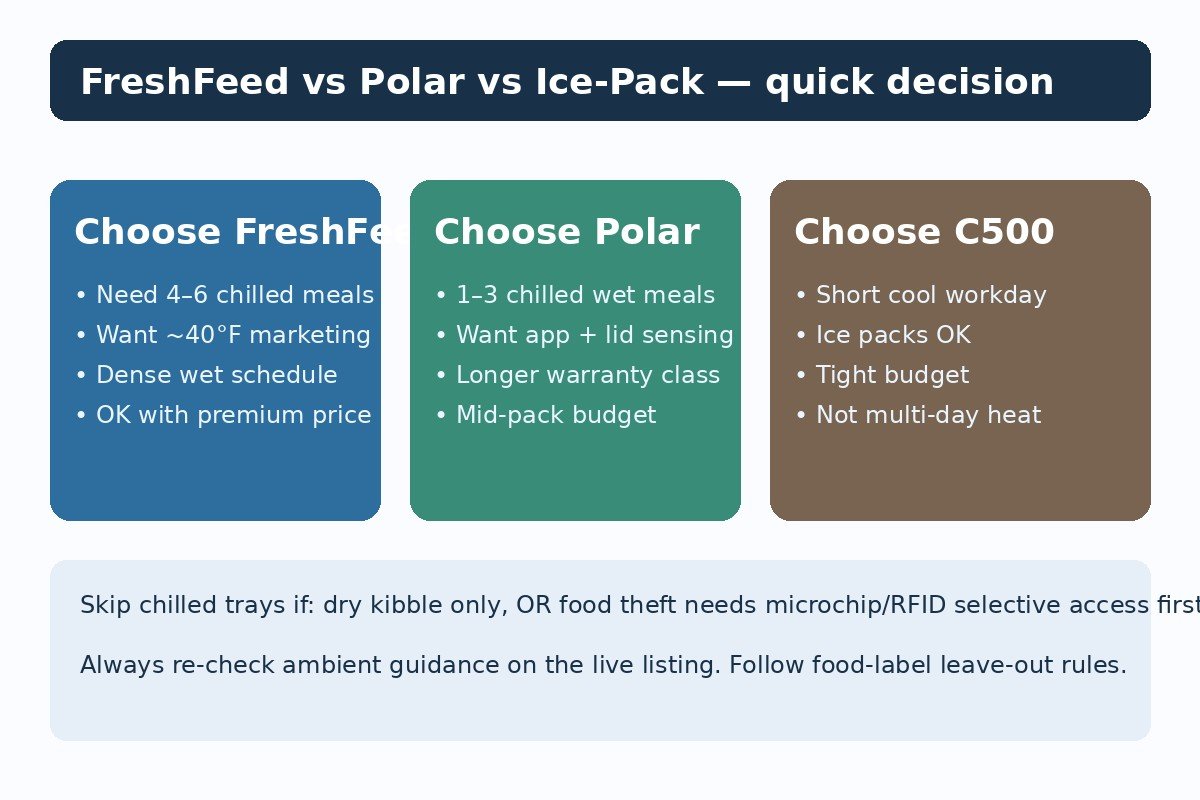
PetSafe FreshFeed vs PETLIBRO Polar is mostly a meal-count and cooling-claim decision: FreshFeed is the six-meal, dual-semiconductor pick PetSafe markets around 40°F for denser wet schedules; Polar is the three-meal semiconductor-chilled pick with app control and a longer warranty class for many weekday patterns. Neither replaces your food label’s leave-out rules, and neither solves food-stealing between cats—that needs selective access. If your window is short and the room stays cool, an ice-pack tray like Cat Mate C500 can still be the rational third option. This is product education, not veterinary advice—call your vet for appetite or diet changes.
Alan is the owner of two dogs. Editorial note: We may earn a commission from qualifying Amazon purchases via tag smartpetcomfo-20. Full affiliate disclosure appears at the end of this post.
Quick verdict — who should buy which
Takeaway: Buy FreshFeed for six chilled slots and colder marketing; buy Polar for three weekday meals and lower early-adopter friction.
- Choose PetSafe FreshFeed if you preload four to six wet meals, want the strongest refrigeration-class claim currently marketed on Amazon (~40°F dual semiconductor), and accept a premium price plus a newer ownership history.
- Choose PETLIBRO Polar if one to three chilled wet meals cover your workweek, you want PETLIBRO app scheduling / “Feed Now,” lid-sensing safety marketing, and a 24-month warranty class on many listings.
- Choose Cat Mate C500 (ice packs) only when the leave-out window is short, the room is cool, and you will freeze packs solid—never as a fake refrigerator for hot multi-day trips.
- Skip both chilled trays if you mainly need timed dry kibble, or if the real problem is one cat raiding another’s wet food—start with our microchip vs RFID and best microchip cat feeder guides.
For the full cooling taxonomy (true refrigeration vs semiconductor vs ice packs vs sealed trays), keep our pillar open alongside this head-to-head: best refrigerated wet food cat feeder.
Spec comparison table (2026 model notes)
Takeaway: The decisive deltas are meal count (6 vs 3), cooling claim (~40°F vs ~54°F lab at 77°F room), and warranty length—not “which brand loves cats more.”
| Factor | PetSafe FreshFeed | PETLIBRO Polar | Cat Mate C500 (backup) |
|---|---|---|---|
| Cooling method | Powered dual semiconductor; marketed ~40°F refrigeration when used as directed | Powered semiconductor chill (no ice packs); brand lab ~54°F food at 77°F room | Twin ice packs (passive) |
| Meals / capacity notes | 6 rotating meals; ~4.5 cup total; up to ~3/4 cup (~5.5 fl oz) per compartment per PetSafe scheduling docs | 3 chilled wet meals; wide trays up to ~6.76–7.4 oz per portion on Polar marketing (SKU-dependent) | 5 compartments (timer + initial window) |
| Empty cadence estimate* | ~3 days at 2 wet meals/day before reload | ~1.5 days at 2 wet meals/day before reload | Depends on pack freeze quality + room heat |
| App | PetSafe Pet Companion (2.4 GHz Wi-Fi); no subscription required for core scheduling per brand | PETLIBRO app (2.4 GHz Wi-Fi common); Feed Now / schedules; no ice packs | On-device digital timer (batteries) |
| Trays / hygiene | Removable stainless inserts; dishwasher-safe per brand | Stainless bowl option on verified ASIN B0F65M9JYS; dishwasher-safe tray marketing | Dishwasher-friendly lid/bowl parts per brand |
| Warranty class (typical listing) | ~1 year limited (PetSafe) | ~24 months on many Polar listings | Brand standard (check listing) |
| Dated 2026 model notes | Models PFD00-18289 / PFD00-18290; Amazon black ASIN B0GLYYKQQD | PLAF109 / Polar class; stainless ASIN B0F65M9JYS (other Polar ASINs exist) | ASIN B09TCNS1BY ice-pack class |
| Best job | Higher meal count + colder claim | Mid-pack weekday chill | Budget short cool window |
Cooling claims explained — ~40°F FreshFeed vs Polar semiconductor chill
Takeaway: FreshFeed currently markets a conventional refrigeration target; Polar markets semiconductor chill that slows warming without claiming the same 40°F set point.
Both units use powered semiconductor / thermoelectric-style cooling plus insulation so wet food is not sitting at room temperature between servings. That is the shared “no ice packs” story versus Cat Mate C500.
Where they diverge is the published temperature story. PetSafe’s FreshFeed materials emphasize dual semiconductor cooling that helps maintain about 40°F when used as directed, with guidance to keep the unit indoors in spaces that do not fall below about 60°F or rise above about 85°F. PETLIBRO’s Polar FAQ-style materials describe lab results around 12°C / 54°F food temperature when the room is about 25°C / 77°F, with a warm-up pause before serving so food is not ice-cold on the tongue. Those are vendor claims and lab conditions—not a promise your kitchen will match the brochure.
If your shopping rule is “closest to fridge-like storage between meals,” FreshFeed is the clearer marketing fit in this PetSafe FreshFeed vs PETLIBRO Polar matchup. If your rule is “three chilled weekday meals without babysitting ice packs,” Polar still does the job many households need. Hot kitchens, sun patches, and blocked vents punish both. Place either unit away from ovens and windows; treat ambient limits as hard constraints, not optional tips.
Meal capacity and empty cadence estimates
Takeaway: At two wet meals per day, FreshFeed’s six trays roughly double Polar’s three-tray buffer—plan reloads accordingly.
FreshFeed’s rotating six-meal tray is built for denser schedules: PetSafe docs note up to about 3/4 cup (~5.5 fluid ounces) per compartment and a total capacity around 4.5 cups across the tray. Polar’s three wide trays target multi-day chill for fewer, larger wet portions (brand materials cite roughly 6.76–7.4 oz per portion depending on version). Neither tray is infinite gravy storage—overfilling causes lid interference and messy rotates.
- 2 wet meals/day preload: FreshFeed ≈ 3 days before empty; Polar ≈ 1.5 days before empty.
- 3 wet meals/day preload: FreshFeed ≈ 2 days; Polar ≈ 1 day.
- 1 wet meal/day + dry hopper elsewhere: Polar often covers a workweek buffer; FreshFeed is overkill unless you want flexibility.
These are planning estimates, not guarantees. Wet food volume varies by brand, gravy, and how you pack stainless inserts. If you travel for a long weekend and refuse to ask a sitter to reload, six chilled slots matter more than three—full stop. For general wet-feeder architecture beyond this duel, see best automatic cat feeders for wet food.
Apps, Wi-Fi, and outage behavior
Takeaway: Both need 2.4 GHz Wi-Fi for app setup; outages interrupt powered cooling—Polar markets schedule retention for a limited window with batteries (not included).
FreshFeed pairs with the PetSafe Pet Companion app for schedules and notifications. Polar pairs with the PETLIBRO app for schedules, Feed Now, and related controls. Brand materials for both emphasize that core scheduling does not require a paid subscription—re-check the live listing before you buy, because app ecosystems change. Expect 2.4 GHz Wi-Fi; 5 GHz-only networks are a common setup fail.
Power matters more than branding slogans. Semiconductor cooling needs electricity. PetSafe’s FreshFeed story is refrigeration while powered; do not assume cooling continues through a blackout. PETLIBRO Polar marketing describes preserving a feeding plan for about 12 hours during outages when batteries are installed (batteries often not included)—that is schedule retention, not continued refrigeration. If storms are common where you live, plan a sitter fallback or a cooler ice-pack backup rather than betting on either unit as an unpowered fridge.
Amazon picks — FreshFeed, Polar, and ice-pack backup
Takeaway: Three verified ASINs cover the comparison: FreshFeed (B0GLYYKQQD), Polar stainless (B0F65M9JYS), and C500 ice-pack (B09TCNS1BY).
Best colder / higher-capacity pick — PetSafe FreshFeed
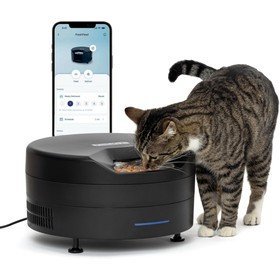
PetSafe FreshFeed Refrigerated Automatic Wet Food Feeder (6 Meals, Black)
FreshFeed is the refrigeration-first answer in this comparison: dual semiconductor cooling marketed around 40°F, six rotating meals, dishwasher-safe stainless inserts per PetSafe, and Pet Companion app scheduling without a required subscription for core features. Quiet operation and a dual-locking lid help on busy weekdays. Plan a corded location under about 85°F ambient guidance, keep vents clear, and confirm the black ASIN matches the color you want (white sibling ASINs exist). Best when meal count and colder storage marketing outweigh early-adopter uncertainty.
Best weekday semiconductor pick — PETLIBRO Polar
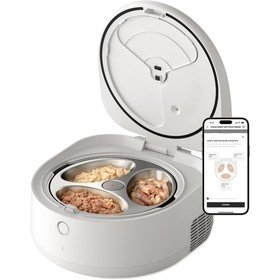
PETLIBRO Polar Automatic Refrigerated Wet Food Cat Feeder (Stainless Bowl)
Polar is the practical three-meal semiconductor alternative: no ice packs, wide trays, stainless bowl on ASIN B0F65M9JYS, anti-pinch / PawShield-style lid sensing in brand materials, and PETLIBRO app control on 2.4 GHz Wi-Fi. Many listings advertise a 24-month warranty class—stronger than PetSafe’s typical one-year limited coverage. It will not match FreshFeed’s six-meal buffer or 40°F marketing story. It will cover many workweek wet patterns without melting packs. Confirm stainless vs plastic SKU before checkout; Polar has multiple Amazon ASINs.
Honest ice-pack backup — Cat Mate C500
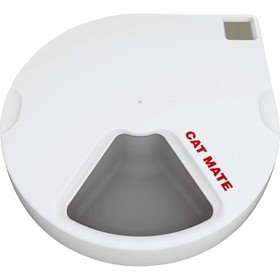
Cat Mate C500 Automatic Pet Feeder with Ice Packs
Include C500 in a FreshFeed vs Polar shopping session so you do not overspend when physics says “short cool window.” Five compartments, digital timer, twin ice packs, and dishwasher-friendly parts per Cat Mate. Freeze packs fully, keep the room cool, and treat melting packs as a hard stop. If you keep wishing for real refrigeration behavior, step up to FreshFeed or Polar instead of buying a second set of packs.
When to skip both for ice-pack, dry hopper, or selective access
Takeaway: Cooling solves temperature and timing—not food theft, and not dry-only households.
- Mostly dry food on a schedule: Buy a dry hopper from our two-cat feeder or wet-food architecture guides—do not force pâté through a kibble auger.
- One cat steals every tray: FreshFeed and Polar control when food appears, not which cat eats it. Use a selective microchip feeder or RFID strategy; for two-bowl household politics see RFID vs dual-bowl for two cats.
- Budget + short cool workday only: C500 ice packs beat unused semiconductor capacity.
- You hand-serve wet food at home every meal: Skip the appliance; spend on litter automation or a camera instead (pet cameras without subscription).
Setup pitfalls — ambient heat, cleaning, portions, multi-cat theft
Takeaway: Most “my chilled feeder failed” complaints are ambient heat, overfilling, dirty trays, or expecting anti-theft identity control.
- Respect ambient limits. FreshFeed guidance centers on indoor spaces roughly 60–85°F; Polar materials warn against hot rooms and direct sun. A sunny kitchen counter can erase the cooling advantage.
- Do not overfill compartments. Leave headroom for lids and rotates. Follow PetSafe’s per-compartment volume notes on FreshFeed; Polar’s wide trays still splash if overpacked with gravy.
- Clean stainless inserts on a cadence. Removable stainless is the hygiene win—only if you actually wash it. Plan dishwasher or hand-wash cycles when you reload.
- Use 2.4 GHz Wi-Fi for app setup. Save hours of troubleshooting.
- Pair with selective access when needed. Cooling + schedule ≠ identity control.
- Follow the food label. A feeder is a tool, not a rewrite of leave-out guidance. Appetite changes belong with a veterinarian.
FAQs — PetSafe FreshFeed vs PETLIBRO Polar
Is FreshFeed colder than Polar?
On published claims, yes in the sense that PetSafe markets FreshFeed around a ~40°F refrigeration target, while PETLIBRO describes Polar lab results around ~54°F food temperature in a 77°F room. Real kitchens vary; follow ambient guidance on each listing.
How many meals does each hold?
FreshFeed: six rotating meals. Polar: three chilled wet meals. That meal-count gap drives most empty-cadence differences in this comparison.
Do I need an app subscription?
Brand materials for FreshFeed (Pet Companion) and Polar (PETLIBRO app) indicate no subscription is required for core scheduling features marketed today. Re-check the live product page before purchase.
Will either work in a hot kitchen?
Performance drops when ambient heat exceeds manufacturer guidance. Move the unit, improve ventilation, or choose shorter leave-out windows—do not expect semiconductor plates to beat a sun-baked countertop.
What happens in a power outage?
Powered cooling stops without electricity. Polar markets limited schedule retention with batteries installed (often not included)—that is not continued refrigeration. Plan a sitter or cooler backup for long outages.
Can I use raw or fresh food in FreshFeed?
PetSafe markets FreshFeed for wet, fresh, and certain raw-style routines while telling owners to follow food-manufacturer storage and serving guidelines. That is not a veterinary endorsement of any raw diet—ask your vet about diet choices.
Is Polar’s stainless bowl worth it?
If you want easier cleaning and less plastic food-contact surface, prefer the stainless Polar SKU (verified here as B0F65M9JYS) over plastic-only listings. Confirm the ASIN photo before checkout.
When should I buy Cat Mate C500 instead?
When the leave-out window is short, the room is cool, and budget matters more than powered chill. If you keep fighting melted packs, upgrade to FreshFeed or Polar rather than stacking more ice packs.
Bottom line and next step
PetSafe FreshFeed vs PETLIBRO Polar resolves cleanly for most shoppers: choose FreshFeed when you need six meals and the colder refrigeration-class claim; choose Polar when three chilled weekday meals, app convenience, and a longer warranty class fit better. Keep Cat Mate C500 as the honest ice-pack off-ramp. Deepen the cooling taxonomy in our refrigerated wet food cat feeder guide, then check current Amazon pricing on your top pick.
Affiliate disclosure: SmartPetComfort.com is a participant in the Amazon Services LLC Associates Program. As an Amazon Associate we earn from qualifying purchases when you buy through links that include our tag smartpetcomfo-20. Product prices and availability change; always verify details on Amazon. We may earn a commission at no extra cost to you. Product claims above summarize manufacturer marketing and publicly documented specs as of September 2026 and are not veterinary advice.