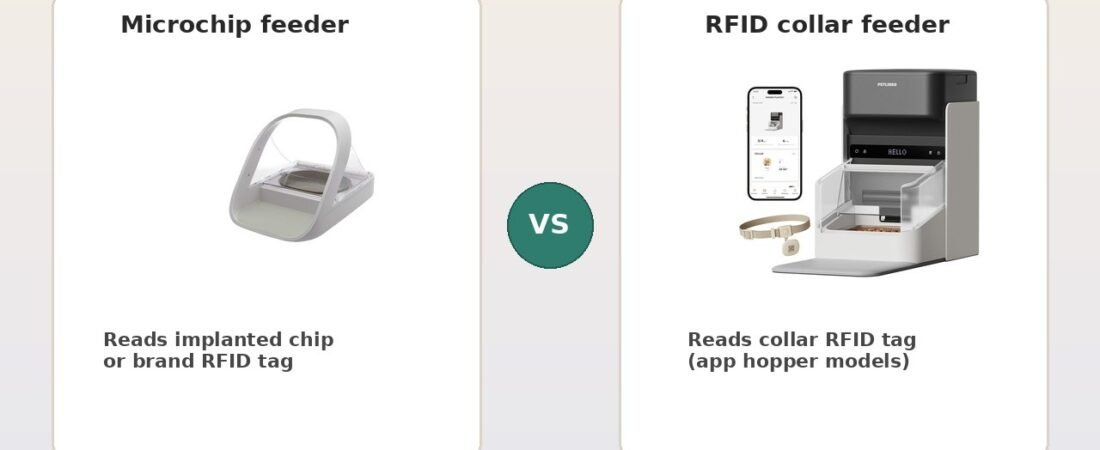
A microchip cat feeder vs RFID cat feeder decision is really a choice between two selective-access architectures: sealed bowls that typically open for an implanted identification microchip or a brand RFID collar tag, versus dry-food hoppers that usually unlock only for a brand RFID collar tag and add app scheduling. If one cat steals another’s meals, or cats need different diets, selective lids beat timed dual bowls for access control. Timed feeders still help portions—they just do not stop a determined thief. This guide defines the tech, walks a decision tree, and shortlists three verified Amazon starting points (SureFeed Microchip, PETLIBRO RFID, and Closer Pets MiBowl). Follow food-label or veterinarian portion guidance for calories; sudden appetite or weight changes deserve a vet visit, not a product swap alone.
Microchip cat feeder vs RFID cat feeder — quick definitions
Shoppers type “microchip vs RFID” as if the words were mutually exclusive. In pet products they often overlap. An implanted microchip is the tiny ID capsule most clinics place under the skin for recovery and medical records (commonly ISO-style IDs). A selective microchip feeder is a bowl with a motorized lid that opens when it recognizes a registered chip—or, on many models, a matching RFID collar tag sold for pets that are not chipped or whose chip is hard to read. An RFID cat feeder in today’s Amazon listings usually means a dry hopper with a collar-tag reader (often a mat or sensor near the bowl) that opens only for the assigned tag and pairs with a phone app for meal schedules.
So the practical comparison is not “radio waves vs chips.” It is sealed selective bowl (chip-capable) versus RFID-tag dry hopper (app-first). Both can reduce food stealing. They solve different food types, setup habits, and budgets. If you are still choosing between one dual-bowl timed unit and two separate hoppers for a peaceful household, start with our automatic cat feeders for two cats guide, then return here when access control—not just timing—is the missing piece.
How selective feeders stop food stealing (and what they don’t do)
Selective feeders close the food when the registered cat walks away. Unregistered pets meet a lid, not an open buffet. That is the core anti-theft job. What selective feeders do not automatically do: create two different diet plans from one bowl, fix resource guarding elsewhere in the home, or replace veterinary nutrition advice. If Cat A needs a prescription diet and Cat B will vacuum anything left out, you generally need one selective unit dedicated to Cat A’s food (and often a second strategy for Cat B)—not a single shared hopper with wishful thinking.
Dual-bowl timed feeders shine when both cats eat the same dry food on a schedule and you mainly want portion structure. They are weak when one cat finishes early and raids the second bowl. Microchip/RFID lids close that loophole. Cameras can show you who visited the station after the fact—useful for troubleshooting—but they do not lock food; see pet cameras without a subscription if you want visual confirmation alongside a selective feeder.
Does a microchip feeder need an implanted chip?
Usually no—not if you use the brand’s RFID collar tag. SureFeed-class microchip feeders are designed to read common implanted IDs and ship with (or sell) RFID collar tags for pets that lack a readable chip. That matters for kittens awaiting a chip appointment, pets with unusual chip placements, or households that prefer a removable tag. Always confirm compatibility on the product page: some RFID hopper brands state they only support their own collar tag and do not read implanted microchips at all.
If a cat loses a collar tag, the feeder will not open for that pet until you replace and re-register a tag (or rely on a still-registered implanted chip, when the model supports it). Keep a spare tag if your thief is persistent. Use a breakaway collar sized correctly; a tag is useless if the collar is unsafe or constantly shed in furniture.
Decision tree — which architecture fits your cats
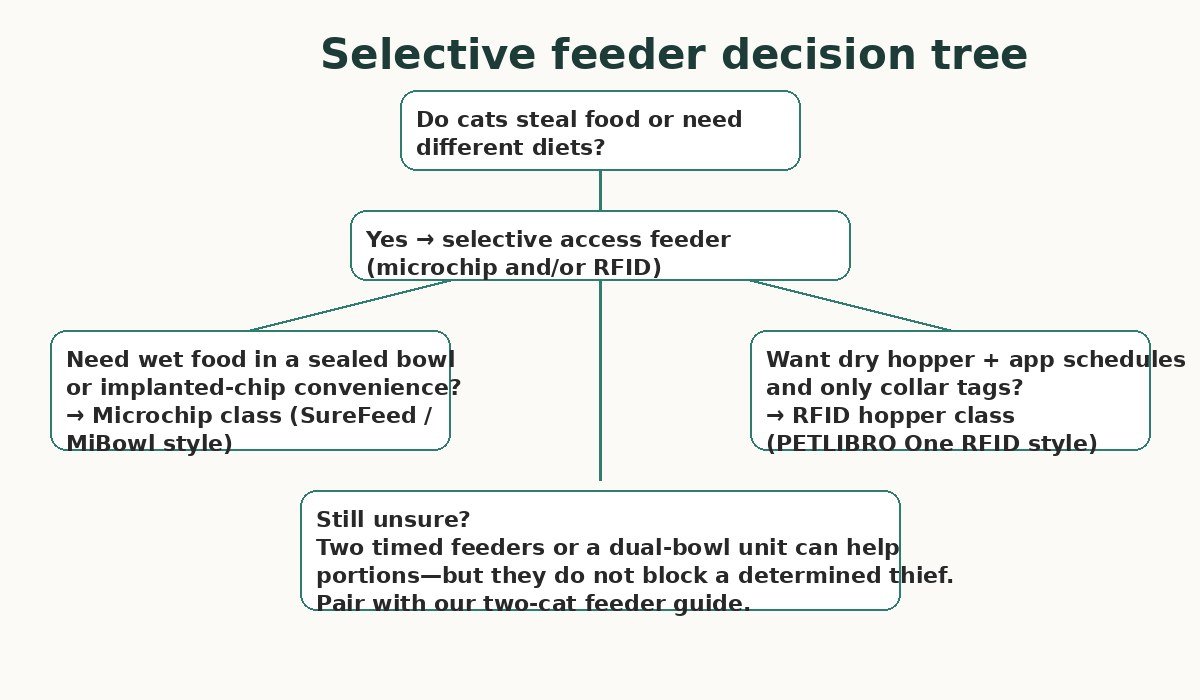
Use this order of questions:
- Is wet food part of the selective meal? Prefer a sealed selective bowl (microchip class such as SureFeed or MiBowl). Dry-only RFID hoppers are the wrong tool for pâté.
- Do you want long unattended dry portions with app schedules? Prefer an RFID dry hopper (PETLIBRO One RFID class) with a stainless bowl you can scrub.
- Is the special-diet cat already microchipped? A chip-capable sealed feeder can skip the collar tag for that pet—handy if the cat hates collars.
- Budget first? Look at compact microchip bowls (MiBowl class) before premium sealed or app hoppers.
- Still mostly a timing problem with the same diet? Consider dual-bowl or two timed units from our two-cat guide before paying for selective lids.
Wet-food automation that cools or rotates trays is a different product family—compare those options in best automatic cat feeders for wet food when refrigeration or multi-meal wet trays matter more than chip/RFID access.
Microchip vs RFID comparison table
| Factor | Microchip-class sealed bowl | RFID dry hopper (app) | Budget microchip bowl |
|---|---|---|---|
| Typical ID | Implanted chip and/or brand RFID tag | Brand RFID collar tag (often tag-only) | Implanted chip and/or ID disc/tag |
| Food type | Wet and dry in a bowl | Dry kibble hopper | Wet and dry in a bowl |
| Scheduling | Usually free-access when registered pet arrives; Connect models add app/hub logging | Strong: app meals and portions | Usually free-access when registered pet arrives |
| Best job | Prescription/wet diets, collar-free chip pets | Multi-meal dry plans, theft blocking with logs | Lower-cost selective wet/dry access |
| Watch-outs | Battery C-cells; training mode; one bowl per special diet | Dry only; spare tags; Wi-Fi bands | Smaller capacity; confirm chip compatibility |
Our Amazon picks for microchip and RFID selective feeders
Real US Amazon listings with product photos. Specs, bundles, and prices change—confirm bowl capacity, power, and whether a hub or extra tags are included before you buy.
Best classic microchip / wet+dry selective — SureFeed Microchip Pet Feeder
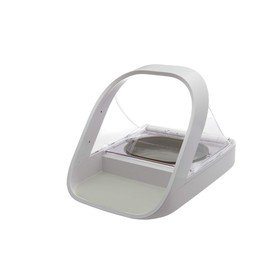
SureFeed Microchip Pet Feeder
Best for: Multi-pet homes that need a sealed selective bowl for wet or dry food, with implanted-chip or RFID-tag access
The established Sure Petcare / SureFlap SureFeed Microchip Pet Feeder opens only for registered pets, helping keep prescription or life-stage food away from thieves. The lid seals against the bowl to help retain moisture. Training mode eases timid cats onto the moving lid. Plan on C-cell batteries (not always included), one unit per special-diet pet, and optional extra tags/bowls. App-connected “Connect” variants exist with hub logging—verify whether the Hub is included on the SKU you click.
Best RFID dry hopper with app control — PETLIBRO RFID Automatic Cat Feeder
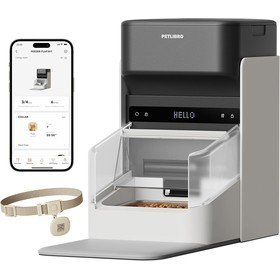
PETLIBRO RFID Automatic Cat Feeder
Best for: Dry-food multi-cat homes that want collar-tag selective access plus app meal scheduling and diet logs
PETLIBRO’s RFID / “One RFID” class feeder unlocks the bowl for the assigned collar tag and keeps other cats out of scheduled kibble. Expect a multi-liter hopper, stainless bowl, adjustable lid behavior for training, and dual-band Wi-Fi on current listings. It is dry food only—do not treat it as a wet-food solution. Buy spare tags if you have a collar-shedder, install the reader mat correctly, and place units a short distance apart if you run more than one selective station.
Best budget microchip selective bowl — Closer Pets MiBowl
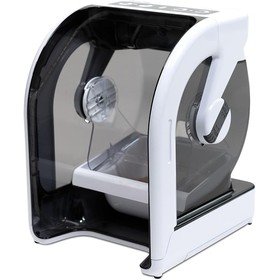
Closer Pets MiBowl Automatic Selective Microchip Feeder
Best for: Budget-minded homes that still need microchip/ID-disc selective access for wet or dry meals
Formerly familiar under Cat Mate branding, the Closer Pets MiBowl is a compact selective bowl that recognizes programmed microchips or the included electronic ID disc. It is a practical step-down when SureFeed’s sealed ecosystem is more than you need, while still blocking casual thieves. Capacity is smaller than tall dry hoppers; measure your portions and confirm battery requirements on the listing. Side clips on some kits help protect smaller pets’ portions from larger housemates.
SureFeed-style microchip vs PETLIBRO-style RFID vs budget microchip
SureFeed Microchip wins when wet food, moisture sealing, and implanted-chip convenience matter most. It is the default “selective bowl” answer for prescription diets and mixed wet/dry households. Expect a higher price than basic bowls and a learning curve with training mode.
PETLIBRO RFID wins when the job is dry kibble on a schedule with logs and remote meal control. It is usually the better “I travel / I work late / I want portion programs” machine—as long as everyone understands it will not serve wet food and that tags must stay on collars.
Closer Pets MiBowl wins on price and footprint for selective wet/dry access when you do not need a tall hopper or a deep app ecosystem. Trade-offs are capacity and fewer connected features. SureFeed Connect-class units (hub + scales + app) sit above the classic SureFeed for owners who want intake logging; confirm Hub inclusion on Amazon before comparing street prices.
One feeder or one per cat? Dual-bowl timed alternatives
One selective feeder protects one food station. Two cats on two different diets typically need two protected stations (or one selective station plus a completely separate feeding room strategy). Registering both cats to the same SureFeed so either can open it defeats the point if the goal is diet separation—only the pet who should eat that food should be programmed for that unit.
If both cats eat the same food and the conflict is mild, a dual-bowl timed feeder or two ordinary timed hoppers may be enough. Escalate to microchip/RFID when you see empty bowls minutes after meals, weight drift on one cat, or a special diet disappearing. Multi-cat households often pair feeding upgrades with litter capacity planning—see best automatic litter box for multiple cats—because meal stress and litter stress show up in the same homes.
Setup pitfalls — tags, training, wet food, placement
- Training too fast: Use training/slow-lid modes. Bribe with familiar food. Give timid cats days, not minutes.
- Wrong food type: Never force wet food into a dry-only RFID hopper. Use sealed selective bowls for wet meals.
- Lost tags: Stock a spare RFID tag; check breakaway collars weekly.
- Crowded stations: Place selective feeders where the thief cannot body-block the rightful eater; give escape routes.
- Water beside kibble dust: Keep fountains a short walk away and prefer easy-clean metals—compare stainless steel cat water fountains and quiet apartment fountains.
- Battery and Wi-Fi surprises: Read whether C/D cells, adapters, or hubs are included. App feeders need stable Wi-Fi bands listed on the box.
FAQs
What is the difference between a microchip cat feeder and an RFID cat feeder?
In practice, “microchip feeder” usually means a selective sealed bowl that can read an implanted ID chip (and often a brand RFID tag). “RFID feeder” on Amazon often means a dry hopper that opens for a brand collar tag and offers app scheduling. Both use radio ID; the product shape and food type differ more than the physics.
Can a microchip feeder work without an implanted chip?
Yes on many models—register the included RFID collar tag instead. Confirm on the manual that your exact SKU supports tags, and keep the tag on a safe breakaway collar.
Is RFID or microchip better to stop food stealing?
Either architecture can stop stealing when only the rightful pet can open the lid. Choose microchip-class sealed bowls for wet/prescription meals; choose RFID hoppers for dry scheduled portions with app control. A dual-bowl timed feeder is usually weaker against thieves.
Will one selective feeder work for two cats on different diets?
Not as a single shared bowl. Program only the cat who should eat that food. The second cat needs a separate station or feeding plan. One feeder per special diet is the reliable pattern.
What if my cat loses the RFID collar tag?
The feeder will not open for tag-only pets until you replace and re-register a tag (unless an implanted chip is also registered on a chip-capable model). Buy spares if your cat sheds collars.
Can I put wet food in an RFID hopper feeder?
No—PETLIBRO-style RFID hoppers are built for dry kibble. Use a sealed selective bowl (SureFeed or MiBowl class) for wet meals.
Is SureFeed better than PETLIBRO RFID?
Neither is universally better. SureFeed is stronger for wet/dry sealed selective access and implanted-chip convenience. PETLIBRO RFID is stronger for dry hopper capacity and app meal programs. Match the architecture to the job.
Should I buy a dual-bowl timed feeder instead?
Buy dual-bowl or two timed feeders when both cats share a diet and you mainly need schedule structure. Upgrade to microchip/RFID when theft, prescription food, or weight divergence shows timing alone is not enough.
Bottom line
For a microchip cat feeder vs RFID cat feeder choice, start with food type and ID preferences—not brand loyalty. Pick SureFeed Microchip when you need a sealed wet/dry selective bowl with chip or tag access. Pick PETLIBRO RFID when dry hopper schedules and collar-tag locking matter most. Pick Closer Pets MiBowl when you want selective microchip/ID-disc access on a smaller budget. Plan one protected station per special diet, keep spare tags, train slowly, and loop in your veterinarian for nutrition or sudden appetite changes. The best selective feeder is the one your rightful eater will actually use every day while the thief meets a closed lid.
Alan is the owner of two dogs. Affiliate disclosure: Smart Pet Comfort may earn a commission if you buy through links on this page. That does not change your price. We do not invent medical advice; talk with your veterinarian about diet changes, weight concerns, or other health issues. See our affiliate disclosure.